






Humanoid or gripper arm
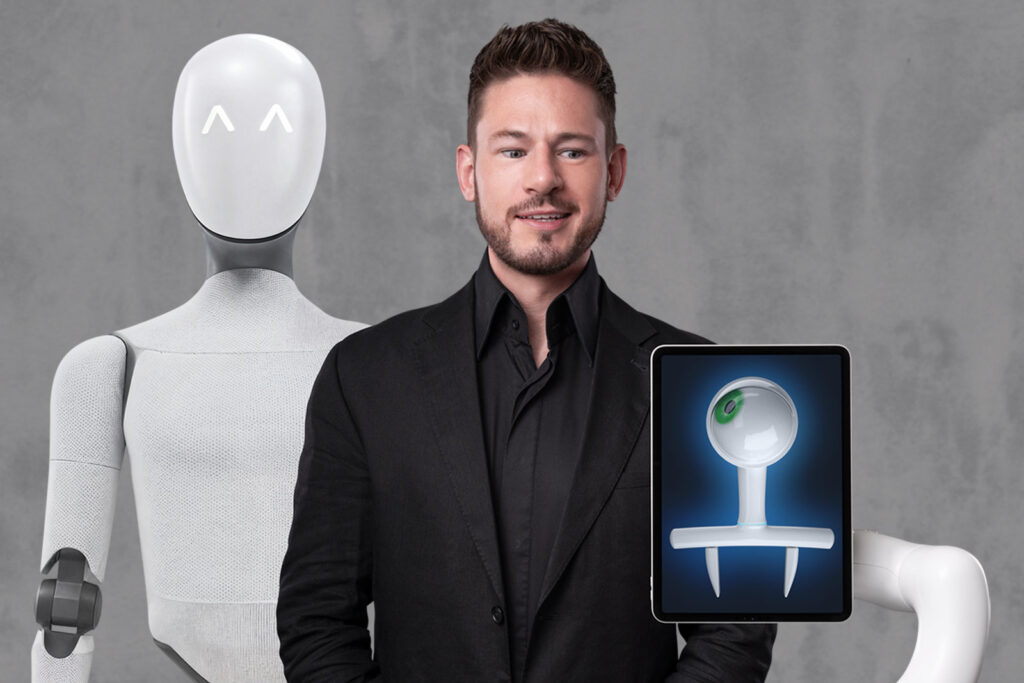
As a digital magician, I’m currently asking myself exactly this question. At events, I’m already working with an abstract robot in the form of a robotic arm. At the same time, I’m developing a second version of the same entertainment concept, this time with a humanoid robot. These are two completely different approaches that are particularly well-suited for events that want more than just entertainment. They represent two different forms of interaction between humans and machines.
Which robot would you rather deal with in the future?
This question has been on my mind for many years—not only on stage, but also in conversations with companies. After all, the more capable robots become, the more relevant the question becomes: What role should they play in our daily lives and in the workplace in the future? Humanoid robots are currently experiencing a tremendous boom. Examples such as Tesla’s Optimus, Boston Dynamics’ Atlas, Figure, Unitree, and NEO demonstrate just how rapidly development is advancing. The idea behind this is understandable: If our world is built for humans, why shouldn’t machines also be designed to resemble humans?
This is exactly where my program comes in. The humanoid robot becomes a canvas for expectations, hopes, and even frustrations. The gripper arm, on the other hand, represents a functional approach in which the task determines the form. Both concepts offer different perspectives on the same question: How do we want to collaborate with machines in the future?
This contrast leads to fascinating discussions, especially at corporate events. The focus is on work environments, responsibility, and the sensible distribution of tasks between humans and machines. Machines can handle precision, repetition, and heavy workloads. Humans contribute judgment, creativity, and social intelligence. On stage, this relationship becomes visible and tangible.
At the same time, a humanoid version is currently being developed
The development of the humanoid version is therefore not intended as a replacement, but rather as a deliberate counterpoint to my existing robot show. For me, the two acts belong together: the humanoid robot as a human-like counterpart, the robotic arm as a practical tool. For event organizers, this results in a format that not only entertains but also provides food for thought.
You can book my “Robotainment” for your event. Here you can find more information about my current robot show.
You are currently viewing a placeholder content from YouTube. To access the actual content, click the button below. Please note that doing so will share data with third-party providers.
More Information