

Can AI Do Art?
As a full-time artist, I ask myself precisely this question and give impulses on this topic in my live shows as a digital magician at conferences and congresses.
Long before artificial intelligence became so ubiquitous, you could buy art in DIY stores, pictures for the wall, neatly framed, to match any living room light. But if you expect more from art than just decoration, you have to ask about its meaning, origin and ethos. When self-driving cars drive us around one day, there will be race tracks where people will be allowed to hold the steering wheel in their own hands. If lab-grown meat becomes the norm, some will choose real meat for special occasions, out of tradition or ritual. There is a parallel here.
The eternal question of original and imitation
Inspiration and imitation have always been part of it, students copy masters, styles move through eras and quotations become dialogs. Today, AI does nothing fundamentally different, only faster, more broadly and more efficiently. It recognizes patterns, combines them and matches what we think is handwriting with astonishing precision. The impression can be confusingly genuine and yet for many there remains a clear distinction between AI and human art. The knowledge of the struggle, the intention, the risk that a human takes when transforming an idea into something visible remains part of the art. It is the small imperfection that we feel, the breath that hangs on the edge of a line. Art as a mere form can be imitated, art as a realized fantasy less so. We measure value not only by the result, but by the way we get there. The question is therefore not “who makes it more beautiful”, but “who stands for what”.
The topic of my show keynote
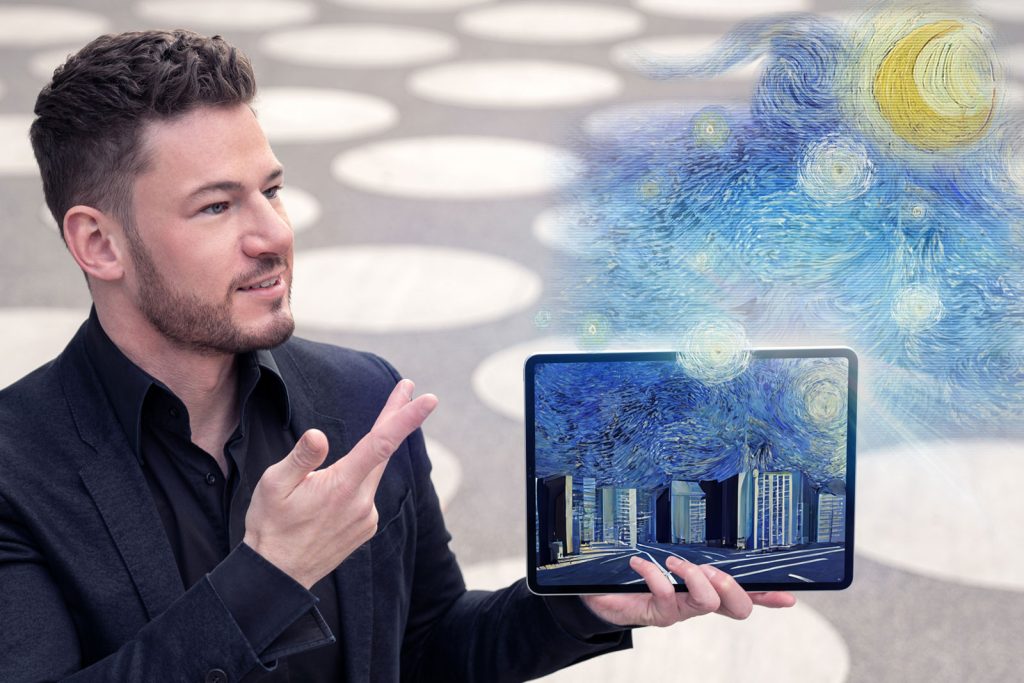
I play out this conflict in my show as an iPad magician. Suddenly, music sounds from off-screen, it sounds like Beethoven. I tell them that the composition was created by an AI and raise my iPad so that everyone can see the glowing surface. Now I’m creating Vincent van Gogh ‘s famous Starry Night live, but over the city we’re in, a scene of art rearranged by AI. Stuttgart, Hamburg, Zurich, the skyline adapts. I explain that, as a human being, I remain the artist, because I guide the artificial intelligence like a paintbrush during the prompting process and am responsible for the result. At that moment, a digital brush emerges from the display and floats in the air above the tablet. I have developed my own hologram technique for this, which amazes the audience. Then the paintbrush also appears physically in my hand, a leap from the virtual to the real, a bridge between AI-supported image generation and handmade art. I go on to say that artificial intelligence is also capable of creating images without my instructions. But people make art because they can and thus broaden their horizons. At this moment, the stars in the digital painting dissolve, emerge from the display into the room and float above the display again. The number does not end with a proof, but with a question: What exactly makes the difference in art if the result is so similar?
The future of art and artificial intelligence
I leave it open in the show and yet I have an opinion. Machines can imitate art, but they don’t want anything. AI has no interest. Human artists draw from biography, body, time, from belonging and contradiction, from joy and loss. Innovation often arises where we break a pattern instead of just varying it, where we consciously break a rule and suffer the consequences. Artificial intelligence remains strong in the combinatorics of the existing, even if its results seem fresh. The value of art is also created in the social space, in studio discussions, in criticism, in scandal, in consolation, in looking at the same canvas together. Even small imperfections, the audible breath of a musician, a tone that has matured too long, a spot that has been painted over, become the signature of the presence of the human being and distinguish human art from machine-produced material.
This does not mean that AI has to remain a foreign body in art. On the contrary, artificial intelligence can be a workshop, a search engine for associations, a supplier of scores, a source of light with which we can explore spaces that were previously hidden from us. The crucial thing is not to reveal every detail of the creative process, but to find ways of making it clear that a work has not been created solely by machine calculation. Those who integrate artificial intelligence into their practice will automatically develop their own ways of marking this human trace so that the art remains recognizable as a human activity. This can be a deliberate imperfection, a personal commentary or the integration of live elements such as a video, a performance or manual interventions in an AI-generated image. All of this is intended to show that a person was at work here who wanted more than just a result.
In this way, the “why” remains tangible and the technology, whether AI or another tool, really serves the message of the art. Perhaps art today is less a collection of skills than an attitude to the world. In this understanding, AI expands our horizons, which I present in an entertaining and magical way in my iPad show.