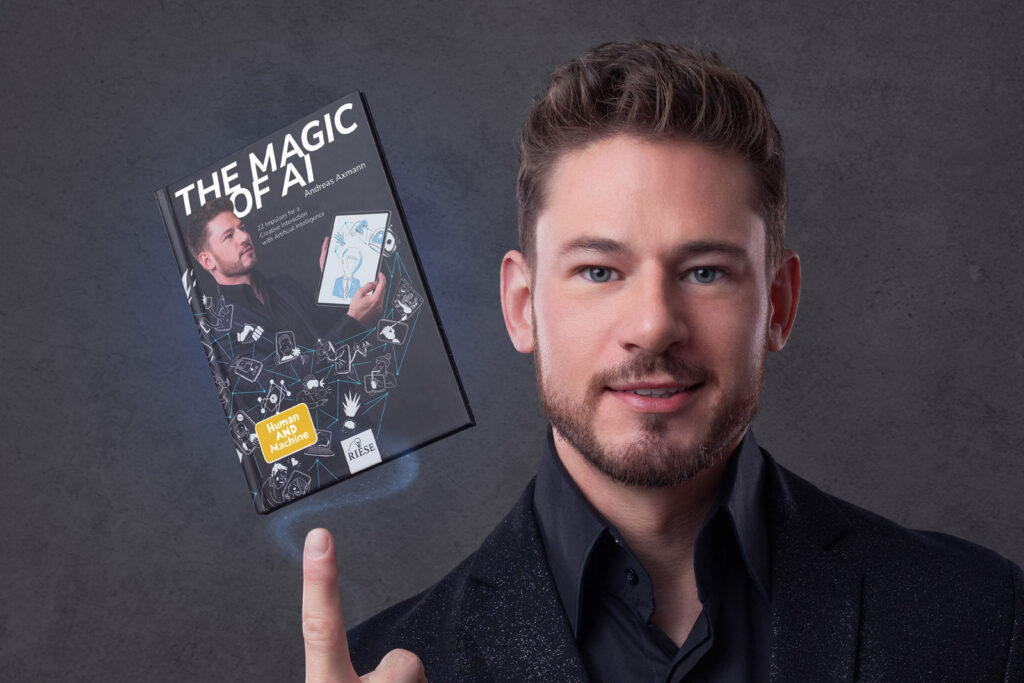



A book about AI that starts with humans
With “The Magic of AI”, I joined the ranks of authors and published a personal non-fiction book about dealing with artificial intelligence
In many debates, artificial intelligence is either a promise of salvation or a threat scenario. Hardly any other topic of our time is so often discussed in superlatives. In my newly published book “The Magic of AI”, I take a different tone. I argue from the perspective of a magician who has been bringing technology to life in an entertaining way on company stages for years. In my book, I focus on the question of what role humans play in an increasingly automated world and what attitude they can develop towards artificial intelligence. This book is therefore also a personal statement by the author.
A magician’s view of artificial intelligence
I have been working as a “Media Magician” for over fifteen years. In my show presentations, I combine classic magic with digital technologies, from iPads to artificial intelligence. This stage experience also shapes my book. “The Magic of AI” brings together 22 short essays, which I as the author see as “impulses”. This book ranges from personal experiences to technological classifications and social issues. The central theme of the book is the relationship between humans and technology. As the author, I repeatedly emphasize that technology cannot be viewed in isolation from human decisions. The decisive factor is not so much what is technically feasible as the question of purpose, which runs through the entire book.
This becomes particularly clear in the introductory chapter “Man with machine”. In this chapter, I as the author describe a situation in which I am offered the opportunity to have an NFC chip implanted in my hand as entertainment for the audience. A small chip that transmits data contactlessly via radio, a technology that would have been both harmless and interesting for a magician. I refuse. I am convinced that technology should not be allowed to enhance the human body. This scene is exemplary for the book. Supposed progress is not reflexively accepted, but consciously questioned. As the author, I am repeatedly concerned in this book with the boundary between meaningful support and possible self-alienation.
Amazement as a human competence
A central motif of the book is amazement. As an author, I don’t see this as pure fascination, but as a productive impulse. Amazement opens up space for curiosity, creativity and innovation. While machines calculate, optimize and reproduce, amazement remains a profoundly human ability. Especially at a time when generative AI produces texts, images and videos in seconds, this idea gains importance in the book. As the author, I argue that the value of human work in the future will lie less in pure production and more in creating meaning. It is not the perfect answer that counts, but the right question, an idea that runs through the book like a leitmotif.
As the author, I deliberately avoid alarmist tones in “The Magic of AI”. Even topics such as deepfakes, blockchain, virtual reality and robotics are not presented as threats in this book, but as tools whose impact depends on how they are used. As the author, I explain technical contexts in an understandable way, often using examples from my live shows. When a laptop appears to float into the cloud or a 3D printer becomes an app, my book is not just about the effect, but about reflecting on what such technologies mean for the human condition.
In the end, “The Magic of AI” is not just a book about artificial intelligence, but also a book about people in the digital age. As an author, I advocate a conscious, reflective use of technology that leaves room for mistakes, detours and humanity. At a time when everything seems to be measurable, this book reminds us that values cannot be calculated.
“Die Magie der KI – 22 Impulse für ein kreatives Zusammenspiel mit Künstlicher Intelligenz” was published by Riese-Verlag on November 20, 2025, ISBN 978-3-384-69105-7. The compact book is available as a hardcover and can be purchased from brick-and-mortar bookstores and online platforms such as Amazon. An English edition supplements the work for an international audience.
You can find more information here.