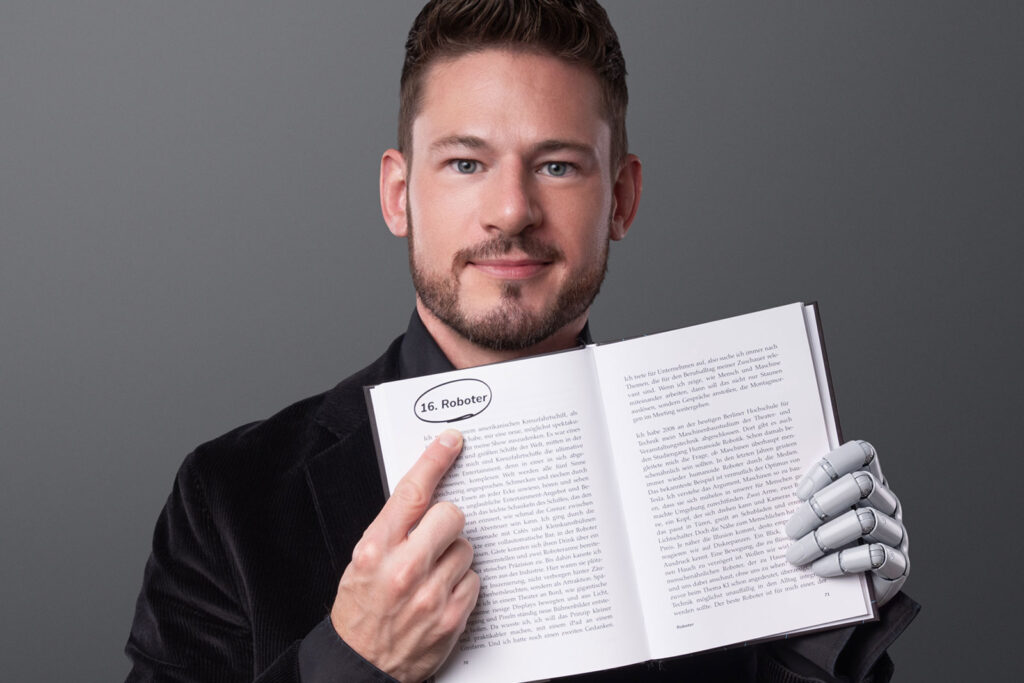



The topic of robots in my latest book
The following text is taken from the chapter “Robots” in my book *The Magic of AI* (ISBN: 9783384691057).
I was on an American cruise ship when I decided to come up with a new, spectacular act for my show. It was one of the newest and largest ships in the world, right in the middle of the Caribbean. For me, cruise ships are the ultimate form of entertainment, because in a self-contained, complex world, all five senses are engaged at the same time. Taste and smell, of course, thanks to the abundance of food at every turn; hearing and sight, thanks to the incredible array of entertainment; and movement, thanks to the gentle rocking of the ship, which reminds the body just how narrow the line between comfort and adventure can be. I walked through the central promenade lined with cafés and small performance stages and discovered a fully automated bar where robots mix cocktails. Guests could customize their drinks via a display, and two robotic arms prepared everything with stoic precision. Until then, I’d known robots mainly from industrial settings. Here, they were suddenly part of a performance—not hidden behind fences and security lights, but as an attraction. Later, in a theater on board, I witnessed gigantic robotic arms moving massive displays and constantly creating new stage sets out of light, movement, and pixels. That’s when I knew I wanted to make the concept smaller and more practical—with an iPad attached to a gripper arm. And I had a second thought. I perform for companies, so I’m always looking for topics that are relevant to my audience’s everyday work lives. When I show how humans and machines work together, I want it to not only inspire wonder but also spark conversations that continue in Monday morning meetings.
In 2008, I completed my degree in mechanical engineering with a focus on theater and event technology at what is now the Berlin University of Applied Sciences. The university also offers a degree program in humanoid robotics. Even back then, I was grappling with the question of whether machines should even be human-like. In recent years, humanoid robots have repeatedly been making headlines in the media. The best-known example is probably Tesla’s Optimus. I understand the argument for building machines that can effortlessly navigate our human-designed environment. Two arms, two legs, a head that can turn and is equipped with cameras—it fits through doors, opens drawers, and reaches light switches. But this resemblance to humans comes at a price. The closer the illusion gets, the more sensitively we react to discrepancies. A gaze devoid of expression. A movement that’s too fluid or just a fraction too slow. Do we really want a human-like robot that vacuums our home while looking at us without actually seeing us? As I’ve already hinted at when discussing AI, I’m convinced that technology should be integrated into everyday life as unobtrusively as possible. For me, the best robot is one that performs specific tasks precisely and derives its form from that task. A gripper arm is honest. It doesn’t promise to be human.
It was precisely with this concept in mind that I developed the new act. On stage, there is no humanoid android, but rather a practical combination of a robotic arm and a tablet. The iPad is the visible user interface; the arm is the executing mechanism. I give the machine a purpose; it gives me reliability in return. For me, that is the essence of “Human and Machine.” Machines bear the burden of precision and repetition; humans are allowed to be imprecise. That’s why, when I perform this act for companies, it’s never just about the effects. It’s about what workplaces can look like—places where robots don’t replace people, but rather open up new possibilities for them. Perhaps that is the most important message of my chapter on robots. Not the dream of an artificial colleague with a friendly face, but the sober beauty of a system that does what it was built to do, so that we humans can do what we were made to do.